
Free Inspection · Written Quotes Within 48 Hours
Spray Foam Removal in Bicester, Thame & Oxford
A surveyor has flagged it. Your mortgage application has stalled. Or you've bought a house and discovered the previous owners had spray foam applied under the tiles decades ago. It's one of the most disruptive things a homeowner can find out about their roof, and it rarely resolves itself.
We remove spray foam from roofs across Oxfordshire. Proper hand removal, an honest assessment of what's underneath, and written documentation if your lender or solicitor needs it. We've handled enough of these jobs to know which roofs come out well and which need a wider conversation

Why Spray Foam Needs to Come Out
Spray foam was applied to thousands of homes in the 1970s, 80s, and 90s as a quick loft insulation fix. It worked, for a while. The problem is what it does to a roof over the following 30 to 50 years , and what it does to your ability to sell or remortgage.
Your surveyor has flagged it
A mortgage survey flagging spray foam is now the most common reason homeowners call us. Lenders treat it as a risk factor and many will decline to lend until it has been removed and the roof independently assessed. The foam itself is not always the issue. What it has been hiding for years often is.
You're trying to sell
Spray foam is a material fact that has to be disclosed, and it sends buyers' solicitors into a tailspin. Getting a removal quote before you list can unblock a sale, or at least give buyers a realistic number to factor in rather than walking away.
Trapped moisture
Foam traps moisture against the underside of tiles and battens. Over time this accelerates decay in the timber structure and causes tiles to deteriorate from underneath, where you cannot see it until something fails.
Hidden tile damage
Foam covers everything underneath it. Cracked tiles, rotten battens, failed underlay, none of it visible until the foam is out. Some roofs are in reasonable shape underneath. Others have been quietly deteriorating for years.
Loft conversion blocked
Visible dip in the ridge line, daylight visible from inside the loft, doors and windows in the top of the house sticking. Could be timber rot, could be structural. Either way, get it looked at.
Visible deterioration
Sagging or partially detached foam, damp patches in the loft, discolouration on the rafters, these are signs the foam has started to fail and the roof needs looking at properly before the damage compounds.
Not sure whether what you have is spray foam or something else? Send us a photo from the loft. We'll tell you what you're dealing with before you do anything else.
How We Can Handle Repairs
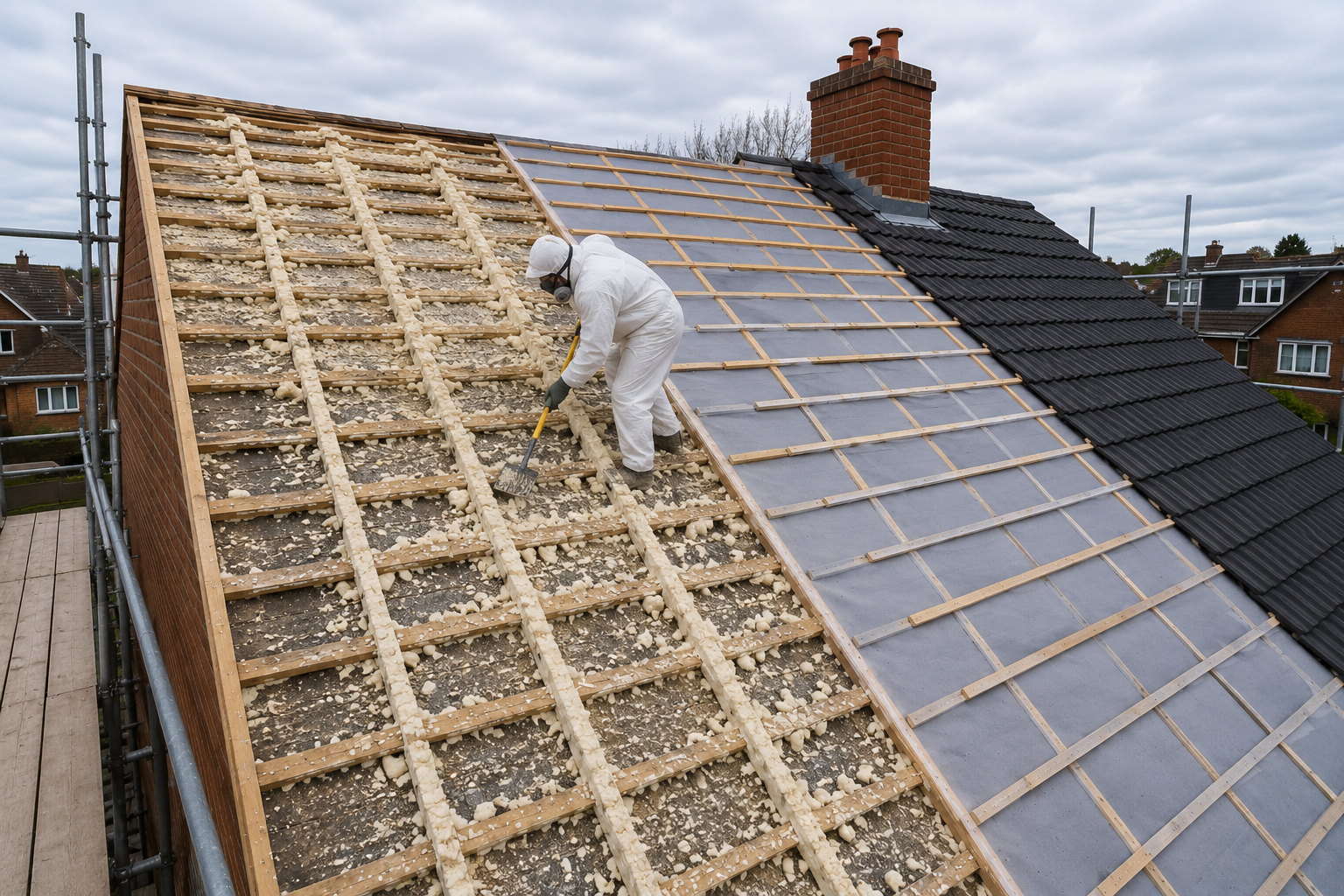
Spray foam removal done badly causes more damage than the foam itself. Getting tiles off cleanly, understanding what is underneath, and leaving the roof watertight, that is the job.
01
We inspect before we touch anything.
We go into the loft and assess the foam type, the condition of the tiles and battens from underneath, and what the roof is likely to need once the foam is out. Closed-cell foam bonds differently to tiles than open-cell, and the removal approach changes accordingly. The inspection tells you what you are actually dealing with before any commitment is made.
We remove it properly.
Foam is removed by hand, section by section. There is no shortcut that does not cost you tiles. Tiles that can be cleaned and reused are set aside. Tiles that are cracked or broken, whether during removal or already beyond use, are logged and included in the quote for replacement. We protect the loft space and leave it clear.
02
We sort out what is underneath.
Once the foam is out, we assess what the roof needs. For most properties that means replacing damaged tiles, re-battening sections where the timber has deteriorated, and fitting new underlay where the original has failed. We leave the roof weathertight and produce written documentation of the work, which your solicitor or mortgage lender can use.
03
The written quote sets out the scope, the expected number of tile replacements, and what the roof will look like once the job is done. If we find something unexpected once we are up there, we stop, tell you, and update the quote before continuing. We never start extra work without your sign-off.
What Spray Foam Removal Costs in Oxfordshire
Honest answer: it depends on the size of the roof, the foam type, and what the tiles look like underneath.
Smaller terraced properties
£1,500 TO £3,500
A standard two- or three-bedroom terrace with a single foam application. Typically one to two days on site. Tile inspection included; replacement tiles quoted based on what we find during the loft assessment.
Semi-detached properties
£3,500 TO £6,500
A standard semi with foam applied across the full pitch. Two to three days on site. Tile and batten replacement quoted once we have assessed the condition from the loft.
Detached and larger properties
£6,500 TO £12,000+
Larger roof areas, multiple pitches, or properties where the foam has caused significant underlying damage. Timescale and final cost depend on the extent of tile, batten, and underlay replacement needed.
The inspection is free. We visit, assess from the loft, and give you a written quote before any work begins. If your mortgage lender or insurer needs a written report, we provide that alongside the quote.
What the Roof Needs After Removal
No two roofs come out of foam removal in the same condition. These are the most common outcomes we find.
Tiles intact, underlay intact
The best case. Tiles are reusable, the underlay is still serviceable, and re-battening in places is all that is needed. Less common on older applications but it does happen, particularly with open-cell foam.
Tiles intact, underlay gone
The foam replaced the underlay's waterproofing function for decades. When the foam comes out, so does the underlay. New underlay and re-battening before the roof is weathertight again. This is the most common outcome.
Some tiles cracked or broken
On some older roofs the foam has masked deterioration building for years. Rotten battens, damaged rafters, failed timbers. We will tell you honestly when what we find changes the scope, before continuing.
Batten rot or structural damage
On some older roofs the foam has masked deterioration building for years. Rotten battens, damaged rafters, failed timbers. We will tell you honestly when what we find changes the scope, before continuing
Roof sound, documentation needed
Some homeowners have had foam removed by others and need a post-removal inspection report for a lender or solicitor. We provide written condition reports independently of carrying out the removal work.
Moving straight to a loft conversion
If removal is the first step in a larger project, we sequence the work correctly. Roof watertight and signed off before any builder or structural engineer goes in.
Not sure whether you need removal followed by repairs or a full re-roof? The inspection will tell you. We will not recommend more work than the roof actually needs.
Common Questions
Will my mortgage lender accept the roof once the foam is removed?
Most lenders will, provided the removal was carried out by a qualified contractor and a post-removal inspection confirms the roof is in acceptable condition. We provide written documentation of the work and can produce a condition report suitable for lenders and solicitors. What individual lenders require varies, so it is worth confirming with your broker before we start.
What type of spray foam do I have?
The two main types are open-cell and closed-cell. Open-cell is softer and spongier; closed-cell is harder and denser and bonds more aggressively to tiles. Closed-cell carries a higher risk of tile damage on removal. We identify which type you have during the loft inspection before quoting.
Does removal always damage the tiles?
Not always. Open-cell foam often comes away without significant tile loss. Closed-cell foam carries a higher risk of cracked or broken tiles, particularly on older clay or concrete tiles. We give you a realistic estimate of how many tiles are likely to need replacing before the job starts, not after.
Can you provide documentation for my solicitor or mortgage lender?
Yes. We produce a written scope of works before the job and a completion report once the foam is out and the roof has been made good. Most lenders and solicitors accept these alongside photographs of the finished work.
How long does spray foam removal take?
A standard semi-detached typically takes two to three days on site. A terrace is often one to two days. Larger detached properties and those with significant underlying damage take longer. We give you a realistic timescale in the written quote.
Areas We Cover
Get a Spray Foam Removal Quote
Spray foam removal is straightforward to quote once we have seen the roof from the loft. The inspection is free and the quote is in writing.
Or call us:
· 01869 931016 (Bicester)
· 01865 679011 (Oxford)
· 01844 614317 (Thame)
Emergency line: 07532 712048
Free inspection · 10-Year Workmanship Guarantee · Fully Insured · Family run